

News
by Berit Krondorf (comments: 0)
What EU CAP means for paludiculture
Supportive but not yet fully
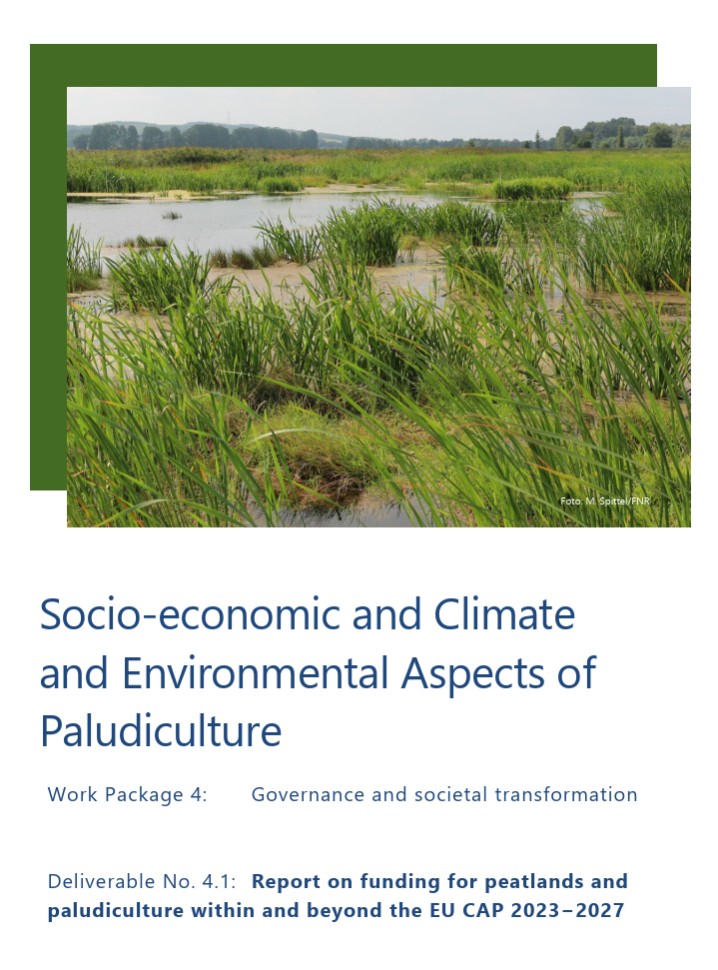
17/04/2026 The current Common Agricultural Policy (CAP) 2023–2027 of the European Union channels €387 billion through national CAP Strategic Plans across the Member States. It creates more opportunities than previous funding periods for peatland protection, rewetting and paludiculture, as a new report issued within the project Paludi4all shows. However, the extent to which these opportunities can be realised in practice, still depends on how Member States reflect the CAP framework in their national strategic plans.
For the first time, the current CAP creates a clearer framework for peatland and paludiculture. It sets a minimum protection standard for peatland and wetland protection, addresses eligibility for direct payments and opens the door for eco-schemes to support paludiculture and peatland rewetting. Beyond this, the CAP toolbox offers further opportunities to advance paludiculture through agri-environment-climate schemes, investment support, cooperation, advice and training.
Direct payment eligibility remains a key challenge for paludiculture. Important paludiculture crops such as reed, cattail and sphagnum moss are still classified as non-agricultural products, and so far only six of the 27 Member States have implemented the new derogation rule that can maintain payment eligibility. Wet grassland paludiculture may still qualify as permanent grassland, but this status can be lost if non-fodder plants become dominant. For farmers and land managers, this creates ongoing uncertainty when considering a transition to paludiculture.
The report estimates, that, even so, the current CAP is becoming more supportive for peatlands and paludiculture, countries including Denmark, Germany, Ireland, the Netherlands and the United Kingdom already provide useful examples. They already show, how different national instruments and policy approaches can work together within and beyond the CAP. Looking ahead, a policy mix could help support the transition. This would include positive incentives for paludiculture and peatland ecosystem services, while gradually phasing out support for drainage-based peatland use. Additional instruments, such as a CO₂ tax, could also help to improve planning security in the long-term.